She thinks people are going to remember her sister for a long time. The One Who Ran. The Shepherd Girl with the Pink Saree. She will not be able to remember her sister. She'll be one of the other ones, because she is not quick-witted or as resolved. She won’t be remembered at all. She'll become another forgotten fragment in the sordid story of the Night Queens.
She is very far from home. So far that she can't even see the road leading to her village from her very favourable vantage point. The guards had given her a tour of the palace before bringing her to her room, leaving her to stare out of the windows while a servant was fetched to draw her a bath. It is, she thinks, likely purposeful that the king chooses to show a girl her new earthly home as Queen before she is taken from it. It is in line with his established ill humour.
She has a little balcony. She had never before been in a dwelling made of more than dirt, with more than one room. She is now as high as three or four of the dwellings back home stacked on top of each other. In the distance, past the palace wall, she can see the roofs of houses and other buildings and market stalls. Her immediate view is a rose garden, with the more mature growth right under her balcony. Younger and younger bushes stretch out, almost yet reaching the palace wall.
Right before the wall there is a little tower made of fresh white stone that rises far above the wall and that can be seen by all of the city. It is where the False Queen lies. His Highness wanted to deny his first queen a dignified death. He denied her a proper cremation and instead borrowed from the Parsis’ death ritual. She was sequestered while, day and night, a beautiful white tower was built at the edge of the grounds. Once it was done, she was slain, and her body and head were taken up the stairs and laid next to each other. Her beloved animals—her fine white tiger, her peacocks, her doves, her chital deer, her trained langurs and macaques, her svelte tamed foxes, her civets, her shy wood squirrels, and her loyal Pariah dog—were efficiently slaughtered and placed around her. He spared nothing that she loved. The vultures came, enticed not only by her body but by those of her animals as well. It was said that His Highness was so filled with spite that at night he had, on occasion, made his way up the tower stairs on his own to witness her exile from heaven.
This was the story so told over and over, from mouth to mouth, no detail spared or embellished, disseminated to every subject in the kingdom.
He has shown the Night Queens more courtesy and mercy. After they drink the poisoned sura in the morning, their bodies are burned in the Way. The rose garden is for them—their ashes are mixed in with the soil before the next wedding is even finished.
Once the new Night Queen is decided upon, the royal guard goes to collect her immediately. In the spring, a girl who was chosen was smuggled to one of the outlying pastoral villages before the royal guard came for her. His Highness had her whole family killed, then tore her out of the upturned cauldron she was hiding in, married her on the spot, killed her, and then killed most of the village for hiding her.
Since that girl, the palace guards are sent for the next Queen each morning. She is slain by breakfast the next day, and her smoke rises before the new Night Queen to-be steps inside the palace gates.
There are only two girls of note so far, of many. The Girl Who Hid. The Girl Who Threw Herself in the River. That was her sister. There are no other girls of note. From the moment the guards stood at the door, her sister had made a run for the brisk, cold mountain river they knew so well. By the time she was at the edge, she'd already managed to tie her saree around a large rock. Those who were there at the edge of the river—her cousins cleaning their clothes and her uncle watering his goats—saw her cradle the rock to her breast. They knew it was her by her unmistakable pink saree.
They said that she never looked at them and did not even turn as the guards came up behind her. Before they were arm's length, she was gone in a graceless dive into the fast-running water. The river wrapped her in his embrace, deep, down below his waters, to his very chest. His Highness was sufficiently furious that he ordered the guards to comb the river for her, but the gods, bless them, saw it fit to deny the king that victory. Such a quick wit she was, her sister. In seconds, she chose to run from her fate in a way that would deprive the king of a body to revenge upon. Though, if she thinks on it, she is the body the king will revenge upon.
She has not seen seen the king yet. She won’t see him until their wedding, and she’ll be kept here until then. She has a bare but magnificent room. The carpets covering the floor are so red and so fine. The sun peeks in through wood lattices, illuminating the large copper bath in the room and the little bits of iridescent stones inlaid across the dressing table. The finest dress she's ever seen hangs in the middle of the room, headless, like a spectre of the False Queen. She is still wearing her dirt-coloured dhoti. The dress before her is a vision of red and gold, the embroidery like little stories along its edges. She is afraid to touch it. She has never been allowed to touch anything so rich. And yet she'll be wearing it soon enough.
The door opens and a servant comes in to help her bathe. The servant patiently gestures at the copper bath, miming shedding her wraps. She crawls in gingerly as the servant pours pitcher after pitcher of warm water around her. It is strange, not at all like the bracing river water of her village. The water turns brown, and she knows enough to be embarrassed. The soon-to-be new queen hasn't had a bath since the wet season. The servant, whose eyes are everywhere but on her, is somehow still precise in her movements, rigorously rubbing her skin flush and oiling her hair, neck, and arms with something wonderfully fragrant but completely foreign to her.
"Please, what is it called?"
The servant does not look up. "It is made up of many things, my meree shahazaadee: oil from neem, flowers, fruit peels. There are things that the king trades for, also, that come from beyond Kush and Kashmir. I could not tell you what they are, but they are very precious."
Curious, she thinks, to waste something so valuable on someone who will be dead in the morning.
The servant is attentive, brisk, working with a ritualized efficiency that speaks to a lifetime of serving other bodies. She is gone before she can be detained with more questions.
The sun is lower in the sky. There is nothing to do but wrap herself in the plum-coloured saree left for her and sit out on the balcony. The air is still thick with heat. A day before, she would have scorned the sun and pined for dark and cool interiors. Now, there is nothing more lovely or more soothing than the sun’s warmth. She is covered in a film of sweat within minutes, undoing the careful ministrations of the servant. It seems insolent, treasonous even, to undo her transformation into a worthy consort so carelessly.
She reflects on the distance to the ground. Is it sufficiently far to render her The One Who Flew Away? If she struggled in the end, would she become The One Who Refused? The One With the Wrung Neck? She should have known they were coming for her, but she was too wrapped up in her grief over her sister. She should have made some sort of plan in the day that she had in-between their visit for her sister and their visit for her. She should have chosen a means to die as soon as her sister had chosen hers, or at least sometime before the guards had come for her, rather than allowing herself to be taken away. But choosing a manner to end one’s life is really best done instinctively, in the moments between thought, and her ability to act had been hindered by her deep contemplation of her situation.
The other explanation is cowardice.
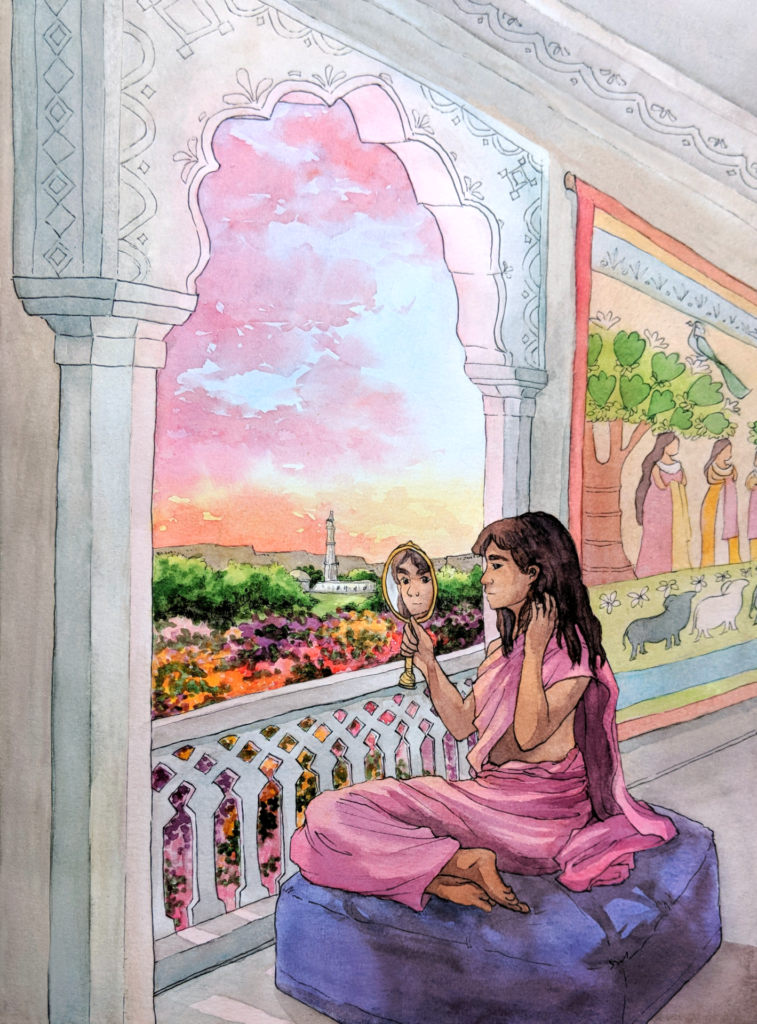
Illustration by Ann Sheng
It is difficult in the villages to know how things unfold in the city. The king only started taking girls from the villages last summer, when the city no longer yielded fruit. Many girls were quick to marry, if they could. Coincidentally, it was then that His Highness made war on the Maurya. He needed men for the campaign, and soon every unmarried man who could carry a bow was deployed. The villages emptied of eligible men, and the news reached the town by winter that the campaign had been particularly costly. Few men would return from the front. In the end, all of the men but one from her village were lost, and the one boy who came back had left both of his eyes in Kush. Parents panicked, marrying their daughters to the infirm, the poor, infidels, Parsis, and foreigners. But still so many unmarried girls remained. There was little else to be done.
Still, it was always a surprise when a girl was taken. At first, it was only the daughters of courtiers, and few in the kingdom worried. Then the king started taking merchant girls as his Night Queens, and, at that, it was like an unreal city tale, told at night when adults thought they were out of earshot of children. At one point, it was said that not a maiden over twelve years of age remained in the city. Then, there were more stories—stories of palace emissaries going to the villages closest to the palace, taking the most handsome girl that they could find immediately, and leaving an edict for a census of all maidens over twelve years.
The process unfolded in the same way in her own village. First he took the mayor's child, and then a few weeks later the guards came for the Xia merchant's girl. The villagers had thought, wrongly, that the king wouldn't care for foreigners. When the blacksmith's girl was taken, her parents truly despaired for her and her sister. They prayed for the king to find love so that his heart would be softened, nay, sated. Even though they were so poor as to have only ever lived a in a dwelling made of dirt, so plain as to have never received an appraising look, and so young as to have only been able to bear this very month, she and her sister were not safe.
There is no smoke today, and for that she is glad. It is a small mercy. She can pretend that the rose garden is only a rose garden, and that she chooses not to walk through it because she prefers to view it from above.
Another courtier enters her room; he insists on drawing her from the balcony to address her formally. He bears a wedding gift: a polished copper mirror with a winding script around its edges. She is truly delighted for a moment, for she has never seen a mirror and has certainly never seen herself in one. He disappears after presenting her with the king’s gift, rushing out of the room as if afraid to be in her presence.
She looks in the mirror and sees what others see: no queen, not even for a night. She sees a face that has seen only twelve years and a shepherd child’s brown skin. Her only good feature is her handsome black brow, like those of the painted courtiers on the wall tapestries throughout the palace. Even her hair could not be said to be a fair trait, all sunbleached and wild. Her sister had been no more handsome. They were both the least that the land had to offer. It was telling that the king had to stoop so low.
The mirror, though—the mirror! Never in her life had she received such a present, nor would she have ever been able to marry well enough to have one.
She feels dizzy with the newness and the richness of it. For a moment it almost seems like a sufficient trade. Better to be a queen for a night than a peasant forever. She'll die a queen, and she imagines heaven will be better for a regent.
She looks at the mirror again. The luxurious script around the edge is scuffed. She can't read it, but she imagines what it might say: a blessing on a wedding day, or an affirmation of beauty. She cannot imagine that it doesn’t enshrine a little hope for the future of the mirror holder. She imagines the previous Night Queens holding up the mirror, imagines their kohled and rouged faces reflected back
.
The mirror was not hers first, no.
There is at least an hour of light left in the day when another servant enters with a plate of food of the most brilliant colour and taste. It’s placed on the verdant carpet in the middle of the room, and she is invited to sit on her own. There is not a single nut, fruit, or spice that she recognizes from her own village. The servant watches her eat patiently, standing barely inside the door as if she is afraid to be trapped with her. She looks up as she finishes eating and tries to make conversation with the silent woman.
"I am grateful, thank you."
The woman blushes. "Whatever pleases Your Highness."
"It's very kind of the king to give me a last meal. I suppose he didn't have to."
The woman flushes a deep crimson as she takes up the empty platter and hurries back towards the door.
"Wait..."
But what she has said is either too terrible or unladylike—which, she'll never know.
A man walks in before she can decide what to do with herself. It is difficult for her to know what the servants’ positions are, or how much deference they expect. They all wear similarly rich, fine clothing. They all have the good health of a generous diet. She begins to feel weary. She had liked the bath and the mirror and the food, but each new entrance is more likely to lead her to her wedding. And then, that would be that.
This man, though, carries many little cases in his arms, brushes and cloths piled on top. "Would it please Your Highness for this servant to prepare her face for this occasion?"
“Yes,” she says, smiling to hide her tiredness.
He sits her down at the ornate dressing table and looks intently at the details of her face as he brushes—over and under her eyes, but never into them.
"Could you tell me," she begins as he starts on her cheeks, "whether you recollect some of the things that our previous queens have received as a wedding gift?" He starts at the sudden burble from the shepherd girl, for a moment meeting her eyes, before darting his gaze back to the stroke of his brush.
"Your Highness, there have been so many queens, and I have not been frequently taken into their confidence."
"Mine was a mirror. I have not ever had a thing so lovely."
He is silent, and she guesses from the little sadness that has crept into his face that he spies the same mirror nightly.
She holds still and looks past him as he works intently on her. Finally, he gently picks up the mirror and presents it to her.
"Please, my lady-to-be, are you happy with it?"
She takes the mirror. Even her skin is paled like that of royalty. Her eyes are swept in black, her lips are bright red like an opened pomegranate. She tries to be complimentary.
"You have done so much with so little. I'm as lovely as all of the other girls, I'm sure."
But at those words his eyes are downcast, not in deference but in the desire to avoid viewing something so tragic. So, these are her last moments—a figure so terrible, one could not lay their eyes upon her.
He exits the room and she takes the mirror out to the balcony, but does not look at it in the dim light. She cannot bear to see herself again, to see and know the look of a girl with only a handful of moments left.
“What should I do?” she asks the garden, or the girls in the garden, or the spectres of the girls. They are a comfort to her, actually, for they are the only ones who can empathize with her and her plight. They have known her fear, and yet now rest calm, peaceful.
“Should I become The One Who Climbed Down the Palace Wall? If I do, will I become The One the Thorns Consumed?”
The roses don't respond.
“This is our gift,” she says to the roses, her voice even startling herself. “Should we not get to keep it?”
The roses remain silent.
She drops the mirror over the balcony. It cuts into the dense bushes, disappearing.
“There,” she calls to the rose bushes, “It is truly ours now.” They are so thick—almost impenetrable—that one would have to be senseless to venture in and try to retrieve something. She pauses, and then speaks into the hazy evening, ”I've given you a gift of sorts. Now, if you can, give me this small thing.” She looks down upon all of the girls in the kingdom gathered under her, no worse than her in their prime and no less deserving of mercy. “I understand that you can't save me,” she says softly to the roses. “But maybe, at least, you can find a way to make me the Last Girl of the King's Garden.” They are becoming less visible in the impending sunset.
There is a knock from inside the apartment. She does not move; she will offer at least this much resistance. There is little else to do than say softly, “Till tomorrow, then,” before she is escorted, civilly, off the balcony and toward the wedding awaiting her below.