When Baba was working at the port near Thatta, he stayed there for weeks at a time. He was due back in a few weeks, just in time for Cheti Chand, and my tenth birthday, which fell at the midpoint of the forty-day festival. Last year, he arrived late at night, in the last hour before my birthday was over. His present to me was an intricate kameez. The skirt’s mirrors reflected shimmery light when he requested, “Darling Kanwal, why don’t you spin around?” I twirled, as though I was three and not nine.
The embroidery kit he gave me on my eighth birthday remained my favourite. I started by stitching uneven swirls and fruits and feathers. It took nearly two years, but Amma finally said my embroidery was so realistic she could mistake a mango for the real thing.
•••
Amma and I spent our mornings together in the garden, me embroidering, her tending to her plants. Amma’s latest garden project was growing periwinkles, the same flower I was embroidering on the border of my chadar. I pushed the needle in my hand through the white fabric, pulling a strand of embroidery thread tight. I went slow, capturing the evenness of the flower’s five triangular petals. Amma helped me pick out a deep pink thread. That was the colour the flowers should be, she had said, rather than the dull grey growing in her beds.
For the first season ever, the stone fruits were ripe above my head. A critter, likely a mongoose or fox, had already gotten to the fruit. A half-eaten mango sat a foot in front of me, sweet and tempting.
“One more flower, then a treat.”
I finished the flower and set the cloth on the dusty ground. Finally tall enough to reach the lowest branches of the mango tree, I plucked a fruit. It was so ripe its skin peeled right off with just a piece of my nail.
My hands sticky with mango juice, I called out to Amma, “Do you want one?”
“Bring some inside. I’ll eat after I wash up.” Still kneeling by the flower bed, she added, “Pick extra for Ramesh Sahib. He’s lonely with his son at the port all the time.”
I collected a small pile of mangoes, then rested against the tree with my knees tucked against my chest. Every time Baba came back from the port, he said I looked more and more like him. Watching Amma hunched over the earth, I only saw her within myself. The same strands of light brown hair peeked out from under our dupattas. We even had moles in the exact same spots, on the sliver of skin between our right eye and hairline.
Wiping my hand on my shalwar, I picked my embroidery up again. The sun’s heat crept above the tree line. Sweat dripped onto the fabric in my hands. Just as a drop of sweat landed in the middle of the flower I was working on, Amma stood up and walked inside. I had one flower left, so I stayed outside, squinting at my work, pushing and pulling the needle through the cloth to create the last silken petal. When I was done, I admired the pink for a moment, bright against the white sheet. Then I followed Amma inside, embroidery tucked under one arm, mangoes balanced in the other.
•••
I was woken up in the morning by Amma’s gasp, loud enough to hear from my room. The curtains were drawn. I stumbled out of the dim room, still in my light cotton sleeping kameez. The back door was open, so I stepped outside to find Amma in the garden. She had an unlit diya in her hand.
“Kanwal, the flowers—”
Blinking, I let my eyes adjust to daylight. And there, where Amma pointed, was a row of periwinkles, dazzling pink in the early morning light. I leaped towards Amma and leaned against her, resting my head on her shoulder.
“I was going to tend to them more today. What to do now . . .” Amma vibrated against me. She pulled away, keeping a hand on my arm so I wouldn’t fall over.
I moved with Amma to the flower bed, crouching alongside her. I skimmed a finger along a petal, silky to the touch. The surface was smooth, but beneath my fingertip I felt soft ridges, embroidery-like.
Amma plucked flowers and sprinkled them into a jug of water. “Good for blood pressure,” she said.
I sipped my periwinkle-infused water while embroidering the next border on the chadar. This time it was marigolds, making hundreds of knots by the time late morning came around. Clusters of yellow and orange popped out of the fabric, forming the tight clusters of marigold petals.
•••
Marigolds bloomed in the garden a few days after the periwinkles. Then yellow and pink frangipani, their scent intertwining with the jasmine on the side of the house. One night, as I lay down to sleep, scorched jasmine petals caught my eye through the window, under the moonlight. The next day, embroidered jasmine vines curled around the inner border of my chadar, sitting next to the thicker, bolder flowers. On the house, the vines came back to life, bright white against the dull sandy exterior of the bungalow. At night, the tiny buds released a sweet scent that cooled the air.
I had leftover orange thread from the marigolds. Next to the jasmine vines, I embroidered a fox’s tail, stitching in towards the centre and out. The tail disappeared into the white flowers. In the afternoon, when I returned to my bedroom to put the embroidery away, a bushy orange tail flashed in the window, scurrying through the vines. I rushed outside fast enough to see the tail disappear over the bungalow’s flat roof. Hoisting myself onto the roof, I found the space empty. Still, I stayed up there, looking out around the city. A new mosque and its domes, commissioned by the emperor, glistened blue in the city’s skyline towards the east.
In just over a week, the garden was lush and alive with colour. The corners of my own mouth turned upwards, and I knew mine and Amma’s faces were mirrored, that we looked more alike than ever.
•••
The day before my birthday, Amma joined me under the tree. She sliced pieces of chikoo, fanning them out on a plate in front of her.
“What will you do with the chadar once it’s finished?”
Threading red through my needle, I made tiny stitches to form the curve of big petals. The hibiscus was the last flower I knew. Since it was much bigger than periwinkles and jasmine, I was only making four, to go in the middle of each edge of the sheet.
“For your bed was what I thought. It could go under Jhulelal’s altar.” The shrine to the river god sat in the front room of our bungalow. “I should make a fish next, if we want to do that.”
Amma picked up a chikoo slice and extended her hand towards me. I leaned forward, taking the sweet slice into my mouth.
“No, it’s too pretty for that.” Swallowing her own piece of chikoo, Amma went on. “It can be yours. A birthday present.”
“Baba will bring something for me.”
When Amma was silent, I looked up from my embroidery. The smile of the past week had left her face.
“Ramesh Sahib from next door heard they won’t be coming back from the port until the last week of Cheti Chand.”
Ramesh Sahib’s son worked at the port with Baba. The son saw Baba more than Amma and I did. The needle in my hand slipped and pricked my finger.
“He always comes back on time for me.” My last words were small, but the air was so still and silent I knew Amma heard them. I sucked my finger where the needle pricked. The skin stung, but there was no blood.
“I hope he can find a way, Kanwal. But he has to work too. He’s trying his best.”
Amma slid the chikoo plate closer to me. She then shifted to my side, even though the ground next to me was uneven and littered with pebbles. Resting her head on my shoulder, she circled my arm with hers. Sliding the needle back and forth into the chadar, I pressed my chin into Amma’s temple. Her sigh reverberated against my chest.
•••
I changed into my nighttime kameez, but didn’t lie down. Tucking the chadar and my embroidery threads and needles into my shalwar, I hoisted myself onto the bungalow roof. I spread the chadar out and settled myself into the middle of the roof. The moon was almost full, reflecting a small amount of light off the chadar. Still, I went mostly off the feel of raised stitches under my fingers.
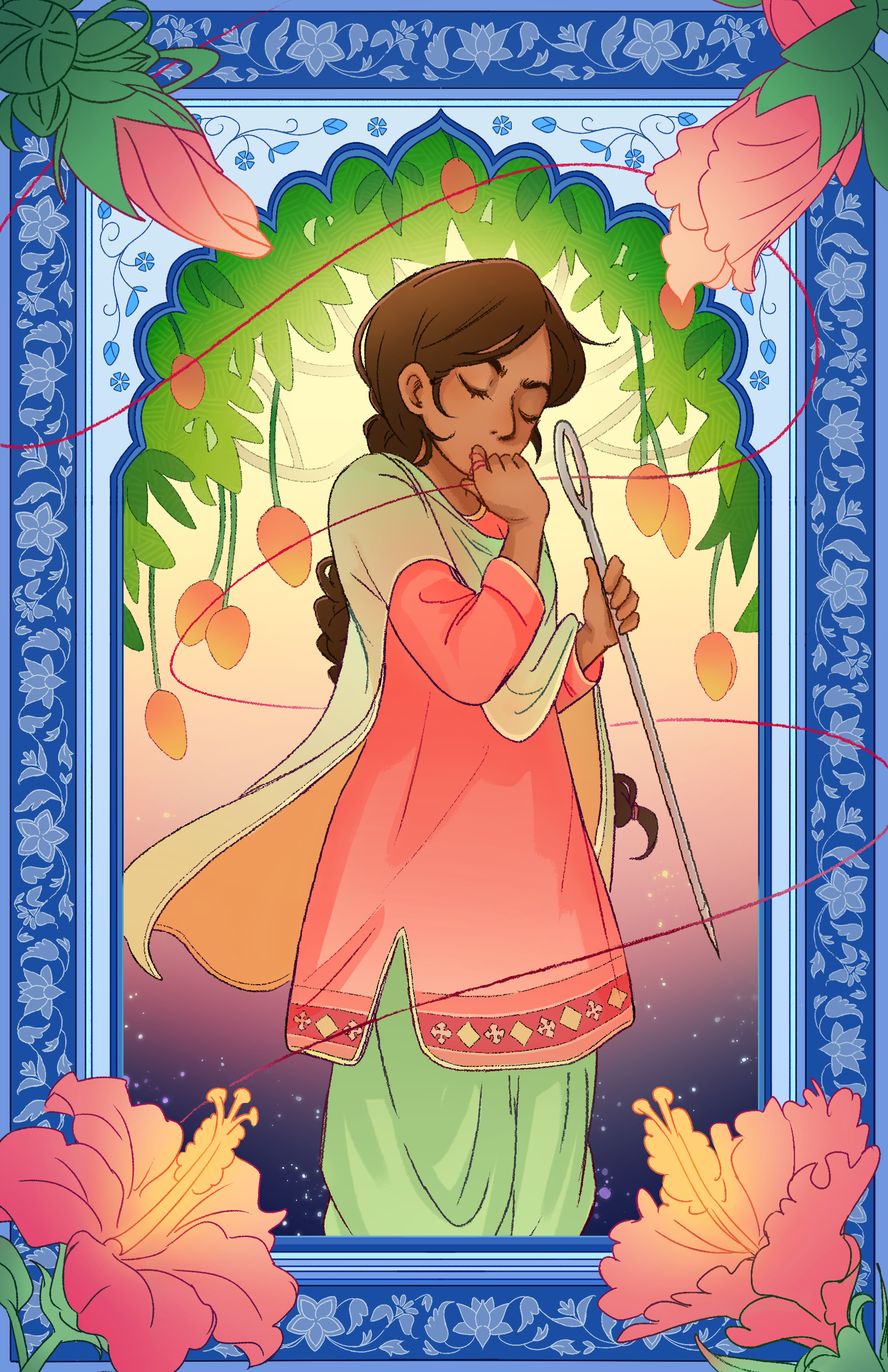
Illustration by Andrea Viñas Notaro
In the empty space in the centre of the chadar, I started with a light brown for my skin, then used the same one for Amma’s. Amma’s face was the easiest to embroider; after so many days in the garden together, I had memorized every wrinkle on her face, every hair that fell on her brow.
When I reached Baba, I started with his eyes, which I knew were black. He had a moustache, and his cheeks were often stubbly. He said I took after his side of the family. Skimming a hand along my own jaw, I replicated the curve on the sheet for his face with a dark brown thread. Unlike Amma’s curls, my hair was coarse. I embroidered Baba’s with the same texture, stem-stitching strands over his forehead and ears.
It was dawn by the time I was finishing up the white collar of Baba’s kurta. The sun peeked out above the new mosque, spreading golden rays over the houses until it shone over Baba’s face. The man embroidered on the chadar wasn’t a stranger, but he didn’t look familiar like Amma, or Ramesh Sahib from next door.
Securing the last knot, I cut the thread and fluttered the chadar out. It settled over the roof. Standing up, I stretched out the cramps in my knees. On the chadar, our three faces smiled at me, mine, Amma’s, and Baba’s. Leaning forward, I pressed my palm over Baba’s embroidered face. I was ten now. It had been five months since I had last seen Baba.
The door opened so softly I almost missed it, but then Baba’s voice carried up.
“Kanwal, where are you? I have the best present for my girl.”
Leaving the embroidery on the roof, I slipped down into the garden, landing in the marigolds. He stood under the mango tree, the smile on his face wider than I could ever have embroidered.
“Baba—” I ran towards him, jumping up into his arms.
He let out a huff as he lifted me, spinning me around until I was dizzy. Setting me down, he squeezed my shoulder. I reached up and pressed my palm on his face. The skin was slick with sweat, and my fingers slid down his cheek like it was silken embroidery.