

The Little Mouse Knight
A Tales & Feathers Story
THE LITTLE MOUSE KNIGHT
by Aaryan Balu
The little mouse knight peered up the trunk and squeaked: “Hail, tree-dwellers! I seek a safe night’s rest.” Her ears remained pricked, listening to the woods for the sound of wily bandits. “As payment,” she added, “I can offer treasures gathered from my travels.”
From above, a voice replied: “No payment, traveller. Only lay down your blade, for there is no violence in our boughs.”
The little mouse knight, whose name was Fen, unsheathed her needle-point sword. Like everything she possessed, it was chipped and rusted from her travels; reluctantly, she drove it into the dirt.
There was a rustle of leaves above; then a wooden bowl descended from the branches. Fen clambered inside with a clink of her tin-can armour—ignoring, despite her belly’s grumbles, the basket of cheese and syrup-filled reed—and tugged the dangling rope, which tautened and lifted her high above the ditches and hills she had long travelled.
Atop the branch, three stout voles grasped at a pulley-wheel; a fourth, plump and habit-clad, bustled forward. “Welcome, friend traveller!”
Fen bowed. “Thank you for your hospitality, er…”
“Dinah,” the mouse supplied, and squeezed Fen’s dented chestpiece in an embrace. “And the pleasure is ours. Come, come!”
Dinah led Fen through a bustling market in the tree’s crown: storefronts carved into hollows and shaded by paper awnings, nimble squirrels springing across the branches with scrolls in their tails, sawdust-covered termites digging behind a barrier of bright red acorns.
Fen clutched her bottle-cap shield. “Where do you keep your warriors?”
“Hm?” Dinah said.
“Your peacekeepers and soldiers. The ones who do your fighting.”
“Oh, there’s fighting!” Dinah chortled. “Arguing, bickering, even a good shouting match when tempers really boil.”
“But violent threats?” Fen pressed. “Sly cats, rat bandits, birds of prey—”
“Fear not, friend traveller. The hawk protects us.” Dinah smiled as if she considered the matter settled. “Come, let’s get you fed.”
Cautiously following her guide, Fen’s sharp mouse nose soon caught the delectable aromas of the feast waiting in the tree’s bowels: roasted acorns and pitted plums, buttered mushrooms and baked berry cakes, aged cheese and dandelion tea—dishes more diverse and plentiful than she had known in her entire life. Varied, too, were her dinnermates: bakers and barbers and carpenters and cobblers, and artists who served and cleaned but spent the rest of their days composing tunes and painting pictures. None were knights like Fen; the closest was a stubby old watch-mouse who had only ever spied a snake (which had turned out to be a springy vine), and even he did not wield a blade.
“But without violence,” Fen would ask, “how do you survive?”
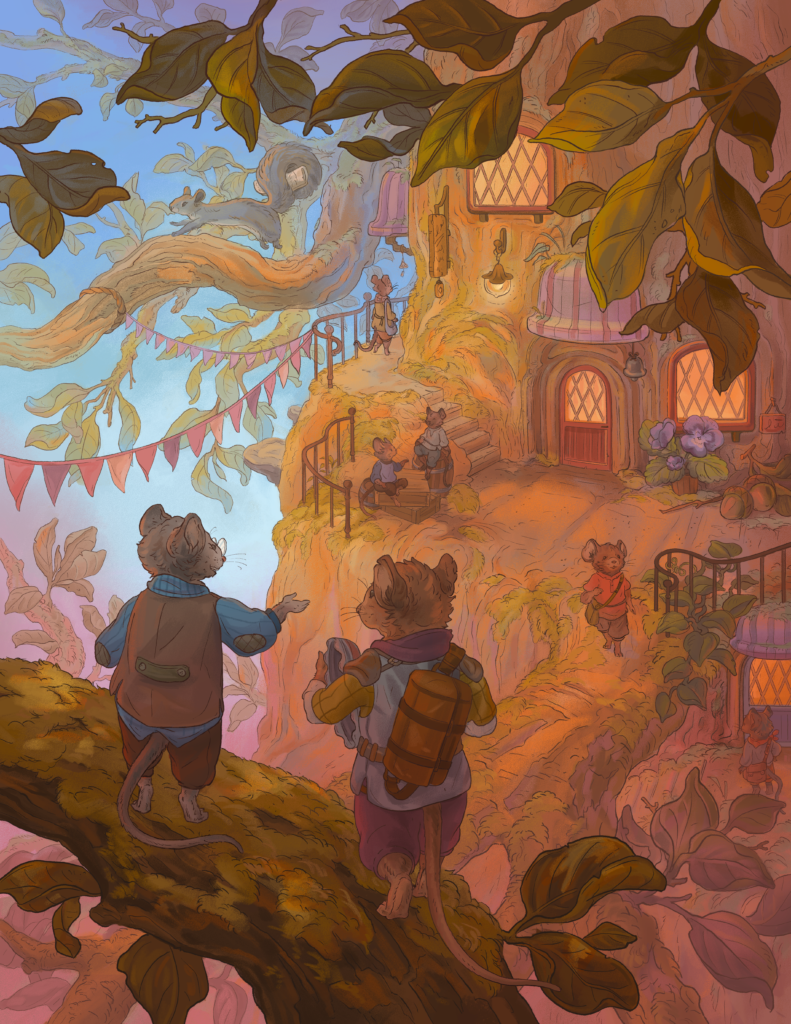
Illustration by Nicole Gustafsson
Each time, she was told: “The hawk protects us.” There was, they claimed, a fearsome bird who had nested in the oak’s upper branches for longer than any of the inhabitants remembered. It sounded, to Fen, like one of many tales to help pups sleep easily—she had believed in them, once, until learning the truth of the world.
Later, as they sprawled around the cookfire, plates cleared and bellies full, Dinah smiled brightly. “You mentioned your journeys, friend traveller. Perhaps you could tell us where you hail from?”
Fen—sitting furthest from the flame, for her tin-can armour was still strapped around her sweating fur—grimaced. “It’s not a happy story.”
There was a long pause. Then someone said, “But it’s yours, isn’t it?”
Fen stared into the fire. Could she tell them? The story of the black-masked ferret and his gang, the fall of her hollowed-stump home, the long seasons of fighting and mourning that had led her to their old oak tree?
After a while, Dinah cleared her throat. “Well,” she said gently. “Another time.” Just like that, the topic shifted to lighter matters. Fen stared into the firelight until her eyes watered, then blinked and turned away. She had chosen wisely; to these sheltered mice, her life would be as foreign as tales of magical swords and cheese-paved footpaths. She did not belong.
Later, then, amid soft snores and the crackle of dying flames, the little mouse knight slipped from the warm feasting-hall and into the brisk night. She sprang between narrow ledges and rope bridges—unseen, for they posted no guards—and retraced her steps to the pulley-and-bowl system that had raised her up to the boughs.
Alas, as she lacked the strength of three stout voles, there was no way to haul herself down. Reluctantly, Fen stripped off her tin-can armour, exposing her scar-mottled fur to the frigid night. She dug her claws into the cracks of the oaken trunk, sniffing the lingering scent of the evening’s meal before steeling her resolve. Life below was difficult, yes, but that was the way of the world. Mice, after all, were prey.
She was partway down when a tired voice warbled, “Come here, little knight.”
Fen’s keen eyes soon found the speaker: a silhouette atop the highest branch, utterly still beneath the stars. Exposed as she was, there was no choice but to obey. With quivering paws, she ascended the trunk and clambered into the nest.
He was old, the hawk, with gray plumage and clouded eyes trained on the glowing moon—but he was still a fearsome predator. And Fen was a mouse, scarred and afraid, without her needle-point blade or her tin-can armour.
But she was still a knight.
Fen said, “You could eat all the mice below. Instead, you shelter them beneath your wing.”
The hawk shifted, shedding feathers. “I hunt to survive, little knight, and no further.”
“They’ve learned to trust strangers blindly,” Fen pressed, “and none know how to wield a blade. You have seen the world from the skies—you know it to be harsh and violent.”
“Perhaps,” said the hawk. “But not in the boughs below. Is that so bad?”
“It’s a lie.” Fen’s whiskers quivered fiercely.
“Oh?” Golden eyes slowly turned toward her. “Here, every little mouse can choose to be a farmer or a baker or a weaver, instead of a knight. Every little mouse can fill her belly in a warm home, not starve in the lonely cold. For a lie,” said the hawk, “it is powerful, indeed.”
“And what will they do when you are gone, old bird?” Wind whistled through the treetops. Fen pressed closer, heedless of the danger. “Without a guardian, they will become prey again.”
“Yes,” said the hawk. “Without one, they will.” And with a rustle of feathers, he turned back toward the night.
In the quiet that followed, Fen ran a paw along her scar-ridden chest—the works of long, painful seasons that divided her from those sleeping peacefully in the boughs below. But as they sat together, hunter and hunted, gazing out across the moonlit woods, the little mouse knight wondered if there still was a place for her, after all.

AARYAN BALU is a writer, journalist, and improviser based in Chicago. You can follow his Instagram for more.
NICOLE GUSTAFSSON can be found at nimasprout.com.
The Little Mouse Knight was edited by André Geleynse and Helena Ramsaroop. It can be found in Tales & Feathers Volume 4.