

The Purpose of a Pyromaniac Descendent
A Tales & Feathers Story
THE PURPOSE OF A PYROMANIAC DESCENDENT
by Wen Wen Yang
(Content warning: death, homophobia, family estrangement)
I don’t know why I expected the afterlife to be different from my beforelife.
In fact, I hadn’t expected an afterlife at all. As the youngest person in dìfǔ, with no descendants, I certainly didn’t anticipate gifts. I was a first-generation American who had a vague idea of the Chinese holidays, but stopped paying attention as soon as I left home.
I woke up in my grandparents’ home. My chest felt hollow, and I realized I didn’t have a heartbeat. Congenital heart defects are bullshit, by the way.
Nǎinai and Yéye greeted me with much hand-holding. We didn't hug while living.
I wanted to tell them that I’m sorry I didn’t visit. When Yéye was in the hospital, I told my parents I was planning to bring my wife whenever he worsened. She had retained some Mandarin from our college classes. I wanted her to meet the man who taught me how to play mahjong. She taught me how to win.
They didn't tell me Yéye had passed until three weeks after his funeral. At least for Nǎinai, a cousin had reached out, and I had been able to send flowers.
After they had finished wiping their eyes, my grandparents led me to the table with fragrant rice, whole fish, and stir fried vegetables. Yéye no longer made small shuffling steps, but strode with the confidence of a younger man. Cataracts no longer clouded Nǎinai’s eyes.
“I don’t think I should be here,” I told Yéye.
He shrugged, “But you are Chinese. This is the Chinese afterlife.”
During the meal, Nǎinai apparently called every single person in the afterlife. After I had eaten, they started to arrive. There wasn’t a white hair among them. The men wore plaid suits and paisley shirts, with some donning tweed and corduroy. There were even a handful of men with queues and standing collars. The women shone in silk qípáo or satin blouses.
The elders came with fruits and sheepish greetings before pulling out letters in English from their American-born descendants. I’d skim and play a game of telephone through my grandparents’ Wenzhounese and Mandarin, and sometimes charades.
I was a corrupted filter. I could understand the elders’ Mandarin but not Cantonese, and I could tell my grandparents the very simplified meaning in Mandarin or Wenzhounese, depending on if we covered the subject in my college Mandarin courses.
The elders complimented my grandparents on my knowledge. I deserved no applause for butchering their descendants’ news and prayers.
The descendents also sent things that made no sense.
Why would you send your grandparents a BMW when they couldn’t drive?
So, I started driving lessons. In real life, I drove less than a thousand miles per year. When you’re already dead, safety is not the top priority. Mainly, I taught them to stay away from buildings. Someone at the joss paper design company must have had a bad dream about their grandmother driving, because the paper cars started coming with paper chauffeurs.
Some elders were so old they didn’t know what the little blue pills were for. I said they’re for men’s problems, because I didn’t know the Chinese words for erectile dysfunction.
Thankfully, someone eventually burned an English-Chinese dictionary. I wondered what thoughtful descendant sent this along, or if it was from a fire pit for the end of their classes.
I read and mangled the pronunciation of almost every word I tried. After the elders had a good laugh at this American in the Chinese afterlife, we started making progress.
On the first Lunar New Year since I arrived in dìfǔ, my grandparents and I were inundated with money. With a prayer to me, someone sneaked a SAT prep book into the fire. It must have burned for hours.
This was the first thing anyone had sent to me.
“Who sent this?” I asked Nǎinai as I stared at the book. I bet my SAT was different from this cousin’s. It was published many years after my death. How long had I been dead? Death had untethered me from time. Was I here because someone added me to the family altar?
“You can go to them through their picture.” Nǎinai led me to hers, a desk with pictures of all of her grandchildren and great-grandchildren. My college graduation portrait was in a sickly sepia tone. How young I was. My eyes jumped from face to unfamiliar face. All these descendants.
Holding the SAT book, the border around one young face glowed.
I touched the border expecting warmth, but instead found myself in an unfamiliar bedroom. Startled, I gasped and stepped backward, and was back in the room with Nǎinai.
“Done already?”
I shook my head.
She held onto my arm. This time, I braced myself when I touched the picture again.
The younger cousin was studying, eyes red from exhaustion.
“Hello?” I said in English and waved.
Nǎinai squeezed my arm. “You have to wait until she falls asleep. You could also devour their qì to make them tired faster, but it’s not polite. I have to get back, I have a card game with Xiè Ài.” She released my arm and took a step back into the afterlife.
I was careful to only take forward steps as I waited for this cousin to fall asleep. Her room was a mess: empty energy drink bottles stacked on a guitar case, six engineering books with Post-Its along every edge except the spine, posters of what appeared to be the latest boy band covered every wall. On a shelf above her desk sat a small altar to the family.
Just then, she finally laid her head right down on the pages. I whispered in her ear.
“Hey, you don’t need to go to the best school. If you go to a safety school, you’ll have an easier time getting a great GPA. Besides, an engineer from a city university will be paid the same as an engineer from Harvard. Less student debt too with in-state tuition.”
Was student debt still an issue? Was I complaining about horse manure after everyone had bought a Model T?
“It’s all about the connections you make at college anyway.”
I looked over the altar with its fruits and rice. There was a picture of me from LinkedIn, lips tight over my overbite, among the pictures of my grandparents. I had more recent wedding pictures, but I hadn’t shared them. We had been gorgeous in our wedding gowns.
I wondered if I was going to be the family’s patron saint for good grades and college acceptances. In their eyes, it was the last good thing I accomplished.
I stepped backward and returned to my grandmother’s room. She was winning in the living room and shouted at me to join the game.
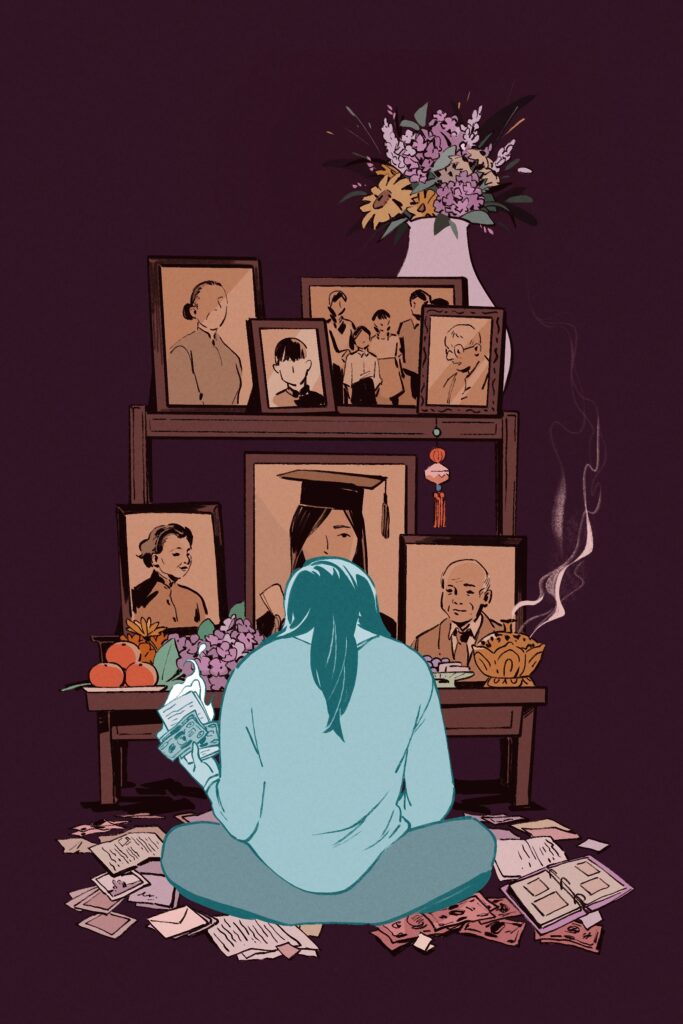
Illustration by Jade Zhang

Sometime later, someone sent a car to my grandparents.
It had a bad black paint job on top of the original red and the driver’s door was dented, so it wasn’t a paper replica. Why did they burn this?
There wasn’t any prayer, as if the sender was just tossing it into the afterlife. I used it for first-time drivers.
Then came another solid car: this time it had leather seats, GPS, wifi.
“What a thoughtful descendant,” the elders exclaimed. I drove my grandparents to the paper cinema where the elders put on plays. Everyone loved “Journey to the West” with Ms. Wáng as the Monkey King.
When the house—a brick and mortar house—arrived, I suggested moving out of my grandparents’ paper home.
“Families live together,” Yéye said as he rubbed his bald head. He’d lost his hair in his thirties and in the afterlife, he didn’t wish for it back. I don’t think I would have recognized him with hair.
Nǎinai peeked inside the windows. “There’s no furniture in there. Where would you sleep?”
“Who sent this?” I wasn’t privy to the prayers directed to them unless they shared.
They seemed uninterested in why someone burned a real house for them. “Maybe it was going to be torn down anyway.” Yéye squinted at the cracked concrete along the foundation. “I don’t like the look of this spalling.”
In the end, we didn’t touch the house, though the other elders came and walked around it like a tourist attraction.
When my grandparents were out, I went down the line of grandchildren, but no one in the first six homes seemed to be the sender.
The SAT-book cousin was now at Cornell. There were cousins having kids, buying homes.
One cousin’s daughter looked like a younger version of me. I sat among her toys, listening to her breathless story of a girl on an adventure with a panda and a dumpster truck. I wanted to look inside her chest. Did her heart have faulty electricity like mine?
“Why is jiĕjie crying?”
Her father followed her eyes but couldn’t follow her vision. I heard him tell her that she didn’t have an older sister.
I returned to the afterlife, disappointed that I had not found the sender among my cousins.
At the next Hungry Ghost Festival, the paper offerings were so numerous that I had to see what caused it.
My grandparents weren’t helpful, saying it was just a part of the festival. But this year’s volume was outrageous—clothes, electronics, even a joss robotic vacuum! We don’t have skin, there’s no ghost dust!
I went through my grandparents’ pictures to their shrines, going down the line of the four aunts and uncles.
I saved my father’s home for last, so obviously, it had to be them. My parents were asking for help with their grandson.
I didn’t know I had a nephew. On the wall was his high school graduation picture, chin raised in mock bravado, the spitting image of his father.
My grandparents hadn’t told me about him, but then again, I’d been scrubbed so forcefully from my parents’ lives, you’d think I was a murderer.
In my parents’ home, I heard their prayers. My parents asked my grandparents if I was now there with them.
So they had been the ones to add me to family altars. Was this an acceptance I could only achieve in death? Or was this a welcome back into the fold because I was needed as a translator again? What a bitter crumb of their forgiveness.
I sifted through their mail like I had done when I lived with them. My nephew was now in jail, awaiting his trial for arson. I wondered what they thought ghosts could do—sway a jury, give a judge sentencing ideas, organize a prison break?
First, I had to get to the nephew. Were they allowed to keep altars in jail?
I found an elder, Mr. Yáo, with a grandson in jail. He kept a small shrine, just a shelf with a few photographs. I traded one of the cars for his permission to venture through the shrine.
I wandered the cells and spied other ancestral altars. Finally, I found the errant nephew. He had a patchy mustache with acne scars in the hollows of his cheeks. I leaned over him in his bunk as he lay sleeping.
He screamed himself awake and poof, I was back in Mr. Yáo’s home.
I shut my eyes for a moment and gathered my strength again. As I wandered the hallways of the jail, I sipped qì from the passing men. Their yawns echoed behind me. Go to bed, I wanted to tell them. You’ll feel better in the morning.
I was in his cell again, and he was awake. Barely. I braced myself this time as I manifested in front of him.
Did he know me? It was unlikely, but the family resemblance likely gave him a few good guesses.
“Are you the arsonist?” I roared.
He was prepared for me too. He stuck out his narrow chest. “M-my father said it’s OK to burn things if you send them to the ancestors.”
I tried to follow his reasoning. “You summoned the Goddess of Mercy and you burned two cars and a house.”
He nodded.
“You could have killed someone.”
He tilted up his chin, sporting five hairs for a goatee. “I didn’t!”
I leaned in close and he pressed himself into the corner of his bunk.
“You are going to therapy.”
He had the audacity to look offended.
“You will make amends.”
“I didn’t hurt anyone.”
“You’re arguing with an ancestor.” This was the first time I’d ever considered that title for myself and it resounded like a low flying jet over LaGuardia.
“You will repay the damage you have done. If you don’t!” I grinned, baring my teeth. “I will haunt you into the grave. Do you want to be in the Hell of Disembowelment or the Hell of Oil Cauldrons?”
He started trembling, looking barely eighteen.
I deflated. There was no pride in frightening a child, no triumph in standing on the other side of ancestor bullying. “Get help, kid. The ancestors are watching you.”
I stomped back from Mr. Yáo’s house, and collapsed onto my grandparents’ patio.
I understood why some ancestors chose to be reincarnated or flung into the Great Beyond.
My grandparents came to sit on either side of me with tea and salty-sweet rice crackers. As I ate and drank, I wondered if my parents had poured as many prayers for me as they did for their grandson. Did my ancestors neglect me or laugh at my parents’ wishes?
“While I was on the other side, did my parents send you prayers for me?” I asked, feeling very small.
“Yes, so many,” my grandfather said. “Your parents worried about you, if you were healthy or warm.”
"I was." I couldn’t share my happiness with my parents because it was their sorrow. My excitement was an open channel for criticism.
My grandmother patted my hair. “And after you came over, they asked us to watch over you.”
I thought of my recent confrontation. “I found my nephew.”
My grandparents exchanged looks. “He’s a troublemaker. You should have had children, they would have been very well-behaved.”
Even in death, I couldn’t avoid this conversation.
“It’s hard with two women,” I muttered.
My grandparents exchanged glances. “You could have adopted.”
I burst into tears, triggering alarmed cooing from my grandparents. My grandmother wiped my cheeks with her fingers, to reveal my joy at their late, late acceptance.

WEN WEN YANG is a Chinese American from the Bronx, New York. She graduated from Barnard College of Columbia University with a degree in English and creative writing. You can find her short fiction in Fantasy Magazine, Apex, Cast of Wonders and more. An up-to-date bibliography is on WenWenWrites.com.
JADE ZHANG can be found at jadezhang.art.
The Purpose of a Pyromaniac Descendent was edited by Toria Liao. It can be found in Tales & Feathers Volume 3.